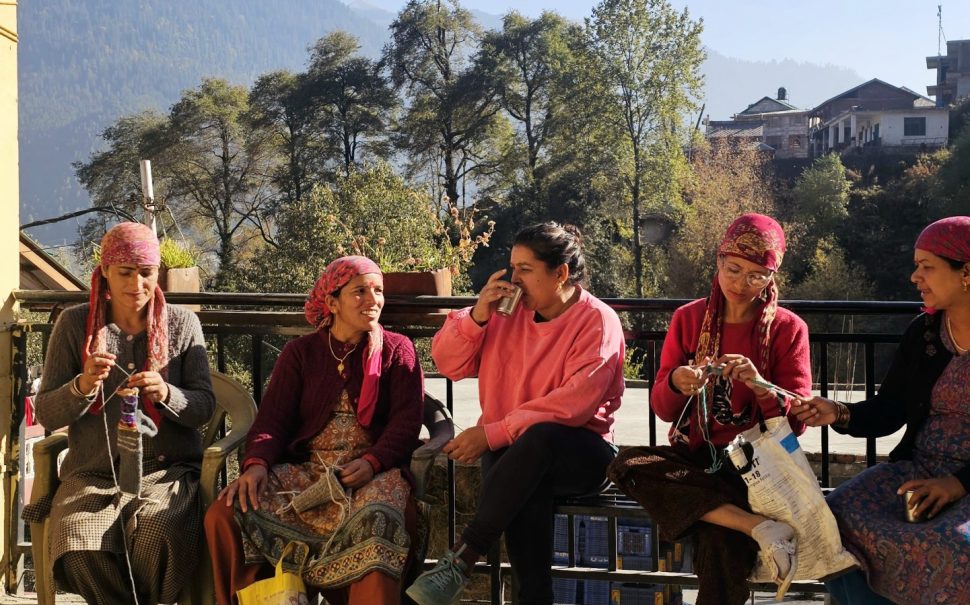
In the snowcapped mountains of the Himalayas sits the high-altitude resort town of Manali.
Situated in the Kullu Valley, the region is referred to as ‘Valley of the gods’ due to its picturesque scenery and beautiful temples.
However, inside this popular Indian holiday spot lives Deepay Dhesi, who has swapped six months a year of fast-paced London excitement for the slower rhythms near the Beas River.
Out of this dramatic change of scenery came an unlikely knitting project between Himalayan mountain women and a former member of the British civil service.
Nine years ago, Deepay was living in southeast London, raising her son, working part-time in communications and making documentaries.
The family decided to take a year break and move to the city of Pune, in western India.
Deepay was born and raised on a farm in Punjab, India, before she moved to London at 11 years old.
However, Deepay soon found that the busy city lifestyle she had in London was replaced by a city similarly preoccupied with money and class.
Therefore, Deepay and her husband decided to move to the mountains – the Himalayan mountains, for a year.
Eight years later, her and her family are still there.
“I just fell in love with it,” she said.
They split their time between Camberwell and Manali.
The Birth of Nasogi Weaves
It was during the COVID-19 pandemic that Deepay got the idea to collaborate with the ladies in her Himalayan community.
In the past, local women would sell items they had made to tourists, but this stopped when tourism did due to COVID.
As a result, the women had few ways to make extra money for themselves, as their husbands do the majority of the paid work.
“Can you imagine saying to your husband, Give me money, I want to buy a lipstick? It’s not good for your self-esteem, isn’t it?” she said.
As a result, Deepay decided to work with the women to knit socks. Now known as Nasogi Weaves.
Deepay buys raw wool from the local shepherds and dyes the wool with natural products herself, which she then gives to the women to knit with.
She said: “I’m taking certain traits from them, and what theyre taking from me is the willingness to learn that you can make money.
“It’s giving them a voice.”
For most families in the mountains, they make money from their cows, turning their milk into ghee to sell.
However, today there are a few shepherds left as the town is becoming focused on the tourism industry, with hotel developments.
“They have a lot of tolerance, endurance, and because they live in the mountains, life has not been that easy for them,” she said.
All the one-off items are knitted based on Deepay’s designs, which have now expanded to include gloves and other winter accessories.
Deepay then sells these items when she returns to the UK on social media and at different design fairs.
Deepay says she asks the women how much they want to make and how much they think they should be paid for their work, and that’s how they determine the prices.
“We are not here to scale our numbers to a profit margin – as long as we cover our costs and we make a little bit of money,” she said.
Stitching together a sisterhood
But working with women in the Himalayan mountains requires a drastically different approach to what Deepay was used to in a major metropolitan city.
“The aim of the project is to give them a way to earn money in a very flexible way,” she said.
“How I conduct myself with the women I am buying wool from is so important.
“The way I communicate in London and the way I work in London, I cannot replicate that here, because there they don’t have the environment we have, so I have to be very patient and understanding.”
In the Kullu Valley, family trumps all – and for women, domestic responsibilities come first.
“For them, work is important, but what is most important is community and the family,” she said.
This is an aspect of mountain life Deepay has grown to appreciate,
“‘Things are lax in London – I think the community,” she said.
After her move from Punjab to Walthamstow, east London, as a child, learning English became her top priority, which left her feeling isolated. A feeling only exacerbated by the death of her mother at 14 years old.
“I didn’t feel a sense of community here.”
Now, Deepay is part of a tight-knit sisterhood.
She said: “I get invited to the weddings – there is so much fun, honest to god, for me it’s no work.”
But ultimately, the experience has taught Deepay to live life at a slower pace.
“It’s taught me a lesson that you don’t need to take these things too seriously. Don’t be in that rat race.”
Featured image credit: Deepay Dhesi
Join the discussion