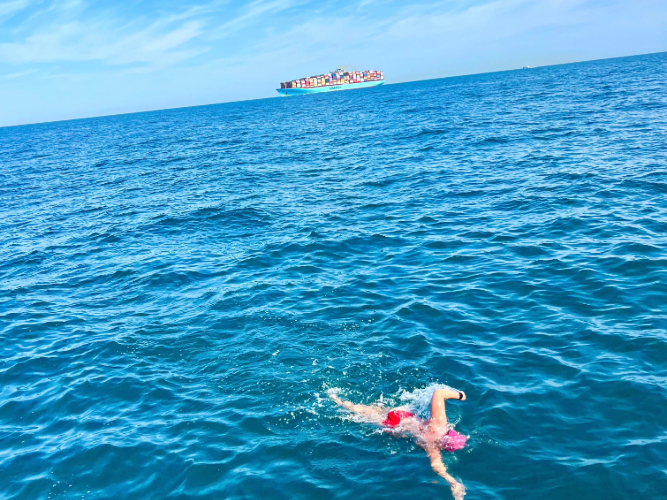
With a gruelling twenty-one miles of cold, choppy sea, the English Channel has challenged even the best long-distance swimmers. Before 1926, no female swimmer had successfully made the trip, until 19-year-old Gertrude Ederle made history with a record-breaking swim. This summer, Bryony Rowe will mark the centenary of Ederle’s monumental achievement with an attempt of her own.
“It feels daunting knowing you can’t get out. A weirdly claustrophobic feeling.”
Rowe recalls a particularly cold training swim she did in Dover Harbour. “I remember putting my head up and thinking ‘I’ve never felt claustrophobic in the sea before, but right now I feel overwhelmed; it would take me ten minutes to swim to shore, so I can’t get out.’”
Now working as a talent strategist in London, Rowe grew up in Newquay, Cornwall, and was enamoured with the sea from an early age. Rowe has been competitively swimming since she was 11 and tackled her first triathlon at age 25. Three and a half years ago, Rowe spontaneously attempted a 10k swim on very little training. Finding it tough but manageable, she completed the same swim three months later, this time doing much better, and her love for a long distance swim was ignited.
Endurance swims became addictive to Rowe as she set the bar higher, completing 15k the following year and then 20k the year after that. Eventually she found herself doing Channel relays and this summer, she will attempt to conquer the “Everest of the open water swimming world”: The English Channel.
With around a 60% success rate, there is a lot of training that goes into a feat like this. Rowe described the structure of her life to hold the impending Channel swim as the ‘sun’ with everything else orbiting around it. With the swim only five months away, socialising has taken a hit and training has assumed sole priority. Rowe swims between four and six times a week, gradually accumulating considerable distances, her current peak being 30k in a single week.
As one of the busiest shipping lanes in the world, the English Channel is strictly regulated and slots to swim it are hard to come by. Rowe will be swimming with the Channel Swimming and Piloting Federation (CSPF) and will have a boat and observer accompanying her.
For her swim to be ratified as a successful unbroken swim, Rowe cannot wear a wetsuit, she cannot touch the boat, and she cannot get out of the water at any point. When the first people to swim the Channel didn’t wear wetsuits, the rules were set and a major element of the challenge was established: withstanding the bitter cold.
To qualify to swim the English Channel you must prove you are capable by swimming for six hours in water that is less than 16 degrees. Rowe does bi-weekly cold water training swims in waters between 6 and 10 degrees. “It’s cold. It hurts your face, hurts your hands, hurts your feet”, she said.
The four members of Rowe’s crew on the boat alongside her will oversee her food. Chewable, high glucose foods will be lowered down to her in a bucket on a fishing wire during the swim, to avoid her touching the boat.
A swim of the English Channel would intimidate most people, with hours swimming in darkness, jellyfish, and the threat of hypothermia. But Rowe sees these challenges differently. Taking on a feat like this, she says, means learning to “get comfortable with being uncomfortable”. What unsettles Rowe isn’t the cold water – or even what might lurk in it – but the possibility of something beyond her control, like an unexpected, ill-timed injury, preventing her from ever reaching the start line. “Jellyfish aren’t so bad, there’s no jellyfish in the Channel that would render me incapable. The only thing I’m worried about is my mind. Being unable to talk my mind into a positive place”, she said. Rowe identifies her own mind as the biggest hurdle standing in the way of success. She recognises how, under the strain of cold and fatigue, her thoughts can spiral, giving rise to irrational fears. During long endurance swims, Rowe tries to anchor herself by fixating on time and feeding schedules, though she admits it’s easy for intrusive worries to creep in. As she explains “it’s less about what I am thinking and more about what I’m not thinking” and keeping any negative thoughts at bay.
When asked if there had ever been a point in the process where Rowe felt like backing out, she firmly shook her head: “No. Absolutely not. Once I’m in, I’m all in.”
Rowe was quick to dismantle the idea that she belongs to a rarified group of athletes. “I was a pretty average pool swimmer,” she said with a laugh. “I wasn’t a shining star. I think it’s important to have average people doing extraordinary things.”
Her journey to this point did not come without its challenges. Rowe suffered from ill mental health and disordered eating as a teenager and young adult. Her conditions contributed to a decision to take a hiatus from sports at the age of 16. Rowe’s coming back into sport at age 25 was part of a wider journey towards respecting, understanding and nurturing her body. Now in a better place where she is comfortable in fuelling her body, Rowe can undertake this demanding venture.
Rowe first watched Young Woman and the Sea, a film based on Gertrude Ederle’s journey, with her Channel relay crew in the cinema, not knowing much about the American swimmer before the film’s release. “It was so amazing as a film, it was so inspiring”, Rowe explained. Six months later, she watched it again at Christmas with her parents, and her resolve was set: “The film finished, and I decided I had to do it.” She said: “I’m going to go and swim the Channel”. Two weeks later, with the support of her parents and fate on her side, Rowe was alerted of a cancellation and miraculously given the date of the 100th anniversary since Gertrude Ederle swam the English Channel on 6 August 1926.
Rowe is heavily involved in charities supporting women and those who identify as women, advocating for increased access for women into sport and so when she was assigned this momentous date it felt like the stars were aligning. She said: “I think everything with my journey for the past four years makes this swim feel like fate.”
Taking this sudden but destined slot meant instead of the standard 2 ½ years of preparation a swimmer would have before undertaking the Channel, Rowe has just 18 months.
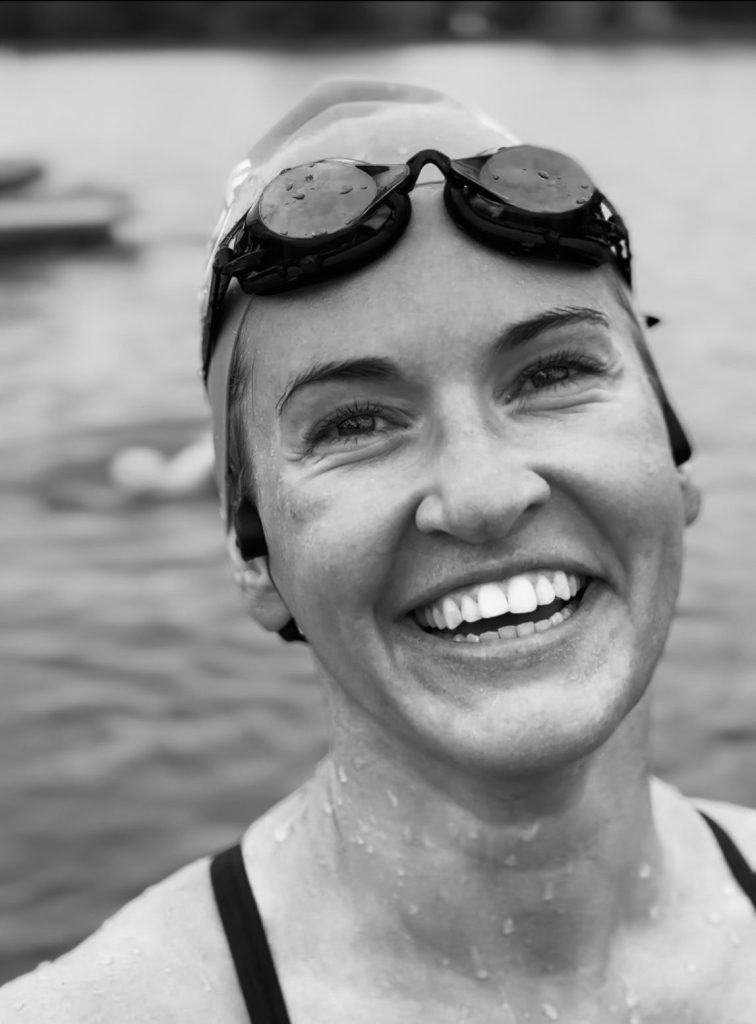
When Rowe first began endurance sports she quickly noticed that “in the ultra world, there’s often far less women”. She said: “It starts to feel like more of a journey towards feeling accepted and like you belong”. Wanting to train with like-minded people and improve equality in sport, Rowe joined 10IronWomen, mentored with Women in Tri UK, and connected with Athlete Interactions, a peer-support mentoring charity founded by former GBR swimmer Amber Keegan. After overcoming a lot of her own challenges, Rowe “would like the journey and the confidence of women, in sports or wanting to get into sports, to feel easier”.
According to the CSPF, out of the 2728 swimmers who have crossed the English Channel in a solo swim only 916 of those are women, making up just over a third of total successes.
Before Gertrude Ederle became the first woman to swim the English Channel, it was a feat that had only been accomplished by five men. In 1920s America, where women were widely seen as the ‘weaker vessel’ her achievement stunned the world. She not only completed the swim but shattered the existing men’s record by two hours. For Ederle, the obstacles she faced weren’t just in the water; even those who were meant to support her stood in her way. She claimed her original coach, Jabez Wolffe, sabotaged her attempt by spiking her drink and pulling her from the water, costing her a swim she believed she could have completed.
Ederle’s achievement altered the sporting world for good. It was reported that more than 60,000 women gained Red Cross swimming certificates in the 1920s, many of them inspired by Ederle’s swim.
The difficulties Ederle faced are still pertinent to the experiences of women in sport to this day. Women currently make up only 17% of Ironman participants, something that the charity 10IronWomen is looking to improve. As stated by Rowe: “There is so much that is getting better, but yet, there is still so much to do”. That said, Rowe feels optimistic about the future of women’s sport with their successes being appreciated more. She said: “We saw it with the Women’s Football, World Cup and the Euros – women are given so much more of an opportunity.”
Charities like 10IronWomen are working towards seeing more women at sporting start lines. 10IronWomen told the Londoners: “Our goal is to create a community to support women in achieving what they might otherwise have thought impossible”.
Rowe recognises that an attempt on the anniversary of Ederle conquering the Channel carries weight. “It feels very poignant,” she said. “It feels like a legacy to want to live up to. I think that can carry pressure but it’s also an honour.”
Featured image credit: Bryony Rowe
Join the discussion