Panellists questioned whether a proposed social media ban for under-16s would protect children, arguing education and regulation may prove more effective.
In the wake of Australia’s decision to restrict online access for under-16s, this year’s question at the London Press Club’s annual debate was ‘Should youngsters be banned from social media?’
The panel included City AM editor-in-chief Christian May, The Independent‘s UK editor Chloe Hubbard, Society of Editors executive director Dawn Alford, Joseph Sparks – headteacher of Leigh Stationers Academy in Eltham- and London Standard trainee journalist Niva Yadav.
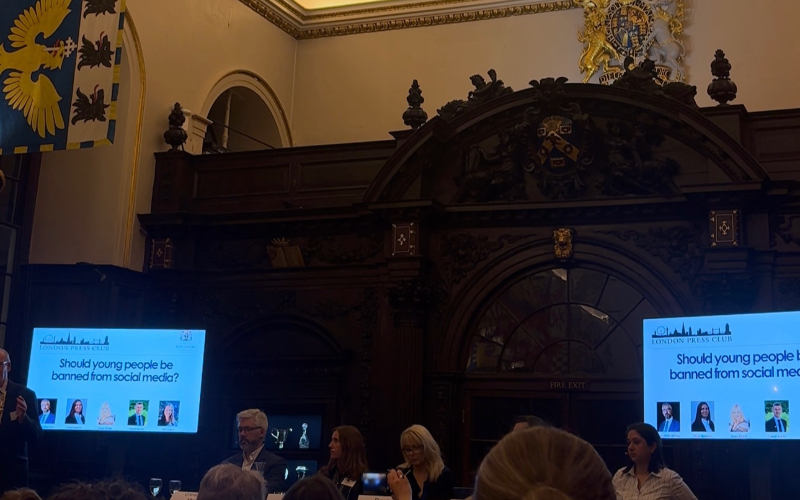
Opening statements from each panellist suggested a neutral standing, with only Hubbard expressing strong views for a ban.
The discussion initially focused on the question of balancing parental responsibility with the role of regulators and educators.
Hubbard’s main concern was that of digitised addiction and the widening of developmental gaps among children who spend over seven hours a day on devices.
As a headteacher, Sparks agreed, and stressed his responsibility to safeguard pupils.
Whilst recognising the inherent good in social connections, especially for the isolated, he noted the foreseeable risks of irresponsible usage.
Safety was a focal point of every speaker’s argument.
Alford warned that a social media ban may push children towards unregulated platforms, such as Telegram, which could harbour gang and drug-related networking.
Indeed, cyber-security expert Patrick Gray previously described this app as “the dark web in your pocket.”
Yadav recognised the presence of harmful content across the digital landscape, but technology companies are reluctant to act as “money talks.”
She said: “Children are our biggest gambling chip.”
Demanding platforms to do more seems redundant, when removing half an audience would corrupt their business models, and, as May added, “clip their own wings.”
As the youngest on the panel, trainee journalist Yadav did not believe children are given enough credit, especially since the modern epoch of communication continues to evolve with this young demographic is actively shaping it.
She said: “We are punishing the wrong people and hiding the target.”
The onus is often removed from the creators of malignant material that children may find on social media, and banning them from these platforms would not change the existence of this content.
However, it may inste3ad force it into much darker digital spaces.
City AM’s editor-in-chief then considered what meaningfully changes between the ages of 15 and 16, questioning if fixed age restrictions could be effective.
He cited Mark Zuckerberg’s appearance last week in a Los Angeles landmark trial, concerning whether social media platforms – including Meta – are responsible for digitised addiction.
The company’s founder ultimately defended his service and pointed out safety features, including Messenger Kids and time-control settings, despite them only beingused by 1.1% of users.
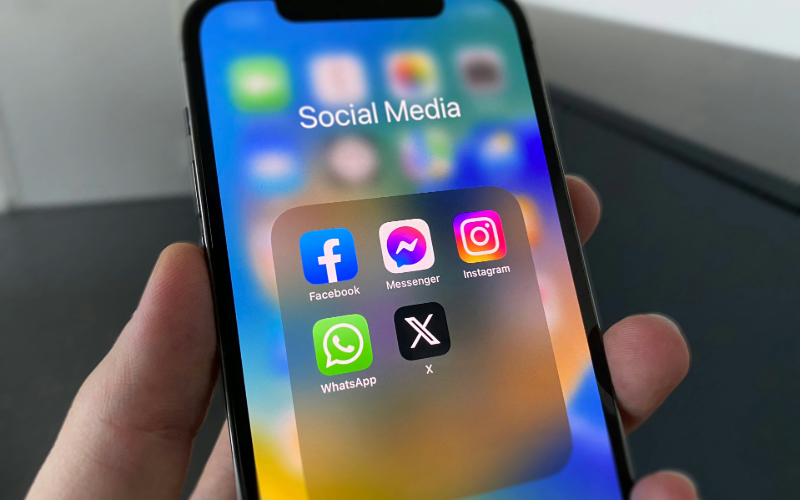
The discussion then moved to how companies actively target children.
Hubbard was quick to claim Snapchat, for example, consciously feeds addiction.
With selfie filters, “best friend lists”, and Snapchat “streaks”, she argued young users are encouraged to use the app as much as possible, entrapped in vicious cycles of dopamine and rejection.
Stationers’ Academy’s principal accepted its compulsive nature, and how it can fail to nurture patience and resilience.
The immediacy of social media delays critical thinking of young minds in a time where perhaps it is needed most.
At this point, it seemed definitions of social media and internet usage were blurred.
With Yadav noticing this, she steered the topic back to calls for a generalised, formal education on safe internet usage, equating it to the sex curriculum and how important that also is for meaningful, digital relationships.
Artificial Intelligence underpinned the debate, with both May and Alford raising concerns of psychosis.
It was noted that ChatGPT currently log over 600,000 users with signs of psychosis a week.
Some children seem to be forming attachments to AI chatbots in place of real-world friendships.
This is especially worrying when Common Sense Media found 72% of children aged 13 to 17 have social media “companions”.

Having reached a poignant moment, May turned to the floor for questions.
The first asked how a ban could work in practice, simply due to the digitisation of homework.
Sparks, perhaps best equipped to respond, explained examination methods aim to replicate ways of working and many students use devices as study tools, while online marking systems can take pressure off teachers.
Nevertheless, he acknowledged the hypocrisy of restricting online access while driving children to complete their studies digitally.
Alford agreed, but suggested it is unfair to put pressure on hardworking parents and educators to control screen usage, whether for study or otherwise.
She said: “Banning devices will not make children read books.”
Her following comment, made in jest but with substance, proposed that social media should be banned for all ages, due to fake news and the romance scams targeting older generations.
City AM’s May repeated phrase “education as inoculation” summarised the outcome of the debate.
In fact, it didn’t seem to be a debate at all, but more an open conversation, in which every panellist settled on one solution – safe usage education is the way forward, and a social media ban for children would not be necessary, nor conducive, to a safer environment.
Feature image: Charli Oakeby




Join the discussion