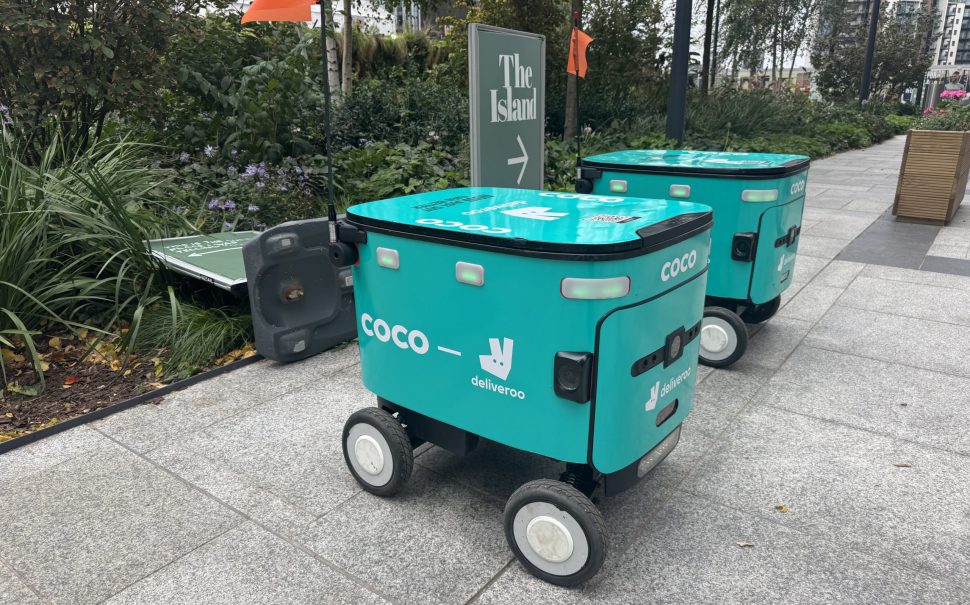
One month into the launch of Deliveroo’s first autonomous delivery robots in the UK, restaurants in Canary Wharf have reported some issues.
Two businesses involved in the partnership with Deliveroo and Coco Robotics, Beam and Signorelli, said they experienced problems during the first weeks of the rollout.
Ugurcan Karaman, a chef at Beam, said: “One time we couldn’t see the order the customer had placed, and we couldn’t communicate through the chats.
“They were waiting for an hour, but we didn’t realise it.”
A similar incident happened at another partnered restaurant, Signorelli, when the store manager reported a failed delivery to the system, as the staff was unable to locate the delivery robot.
The order was binned and a refund had to be processed through Deliveroo.
The store manager said the situation has since improved, and robots are now stationed outside the restaurant during opening hours.
Beam was approached by Deliveroo at the end of September to take part in the rollout, and the staff received training on how to prepare robot orders and use the new system.
Karaman said the restaurant has only used the robots around five times since they were introduced three weeks ago.
Despite the early issues, he said the system is straightforward to use and could eventually reduce waiting times for Deliveroo riders.
The rollout, announced at the beginning of October, marked Coco Robotics’ UK debut and Deliveroo’s first use of autonomous delivery vehicles in Britain.
The service, launched in Canary Wharf, is due to expand to Milton Keynes, Leeds, Stockton-on-Tees and Nottingham.
Deliveroo said the robots would give restaurants greater flexibility while supporting short-distance, zero-emission deliveries.
The rollout also includes a partnership with BlindSquare, a navigation app for blind, deafblind and partially sighted people, sharing real-time information about obstacles on pavements to help improve accessibility.
Ilkka Pirttimaa, founder of BlindSquare, said the technology provides ‘tangible safety improvements’ and that the robots help create ‘a real-time accessibility mapping network’ for users.
But UK charity Living Streets has warned delivery robots could contribute to pavement clutter, making streets harder to navigate for disabled people, older pedestrians and parents with pushchairs.
The charity has written to the Department for Transport raising concerns about liability, privacy and the wider impact of allowing private companies to use public pavements for commercial deliveries.
Living Streets Director of External Affairs, Tanya Braun, said: “Delivery robots present a dangerous obstacle to all pedestrians, but especially disabled people, those who are partially sighted or blind, and families with young children.
“At Living Streets, we want an outright ban on delivery robots on pavements, so that our streets can be safe and accessible for everyone.”
She added that over 2,500 supporters have written to their local MP, while organisations like Wheels for Wellbeing, Transport for All and Walk Wheel Cycle Trust share the same concerns.
A YouGov poll, commissioned by the charity, showed that 80% of people in the UK believe delivery robots could cause problems for blind people and 79% think they could create difficulties for people with mobility issues.
A Coco Robotics spokesperson said: “Safety is core to how Coco was built.
“It’s trained on millions of real-world delivery miles, so it’s experienced everything from crowded pavements to tricky intersections and unexpected obstacles.
“On pavements, Coco moves at walking speed and is designed to yield to pedestrians, slow near obstacles, pause in crowded environments, and avoid narrow or congested paths where necessary.
“The goal is to integrate predictably into city flow, not compete with it.”
Deliveroo was approached for comment but did not respond.
Featured image credit: Arianna Distefano
Join the discussion