I once gave two hiking nuns directions to the Santa Maria de Montserrat abbey via the summit of Sant Jeroni, a mountain outside of Barcelona. It is the closest I have been to heaven; there is power in a good deed. The second closest was at the O2 Arena on Wednesday.
In the beginning, there was darkness – and Jimi Hendrix’s ‘Angel’ playing over the sound system. I am sitting higher than any mortal should be. The orchestra march like ants to their seats, forming a crucifix in the middle of the arena floor. I wonder if God suffers from height vertigo.
It is the second night the London venue is at capacity for the Lux tour. That’s 20,000 pairs of expectant ears and eyes demanding the near perfect recreation of an album that is epic in both scale and scope. After all, it isn’t enough to sing in 13 different languages across at least four different musical genres, telling the stories of female saints, mystics, and one emotional terrorist in recording alone. Seeing – and hearing – is believing. It is a challenge, but then again, two-time Grammy winner Rosalía is no stranger to those.
Emerging from a wooden box en pointe, wearing a white vest and pink tutu, as the orchestra eases into the overture, Rosalía sets the tone for the evening. This will be high art, high energy, high-camp.
“First I will love the world/Then I will love God,” read the English surtitles to ‘Sexo, Violencia, Y Llantas.’ Rosalía’s voice is haunting as it dances across the vocal spectrum, rising from the pianissimo (very quiet) to the fortissimo (very loud) at hardly a breath’s notice. Sometimes it sounds as if she might cry. Several people around me are. So moving is this sequence, so simple and powerful, that it would be unnatural not to.
At the same time, as if hitting a high B flat or the soprano trills of aria ‘Mio Cristo Piange Diamanti’ wasn’t enough, Rosalía’s sweeps across the stage performing ballet moves in a display of radiance and restraint. In a world where more is more is more, to watch one woman take to the stage executing bourrées – small rapid steps – raising her leg en l’air is to celebrate humanity and its artistic potential. It certainly defies one Mr Chalamet and his recent lambasting of the arts.
Perhaps, though, even he could admire the greatness of the show’s dark turn. He would certainly be able to feel it thumping through his ribcage. After the innocence of the opening sequence, we are greeted with the Witches Sabbath by Goya. The singer, now in a black-knit mini dress that reveals a hot-pink bra, wears black horns that protrude from her tumbling black hair. She is the painting’s Satan; her dance troupe, the coven.
Furious, they break free under the ultraviolet strobes. ‘Berghain’ makes strange bedfellows of the concert hall and dance floor; as Germanic choral thunder meets Bjork, techno is the answer. With little refuge from this electronic bombardment – at one point I cannot tell where I begin and the music ends, so loud is the pounding in my head – there is salvation in dancing. Even when the chaos gives way to the more structured percussive hand-claps of the flamenco (‘De Madruga’), the beat merely spurs on the crowd. This is bacchanalia and everyone is invited.
After all, as highbrow as the show unapologetically is, playfulness is the undercurrent. The Catalan star might take her art seriously, and Catholicism too, but herself? Well, that would be no fun at all.
She guzzles a glass of white wine before launching into ‘Sauvingon Blanc’, a gentle melody supposedly about relinquishing life’s material goods in favour of “divine intoxication”. (One might assume she rather likes the drink too.) In an interlude, the audience is invited to recreate famous classical paintings; watching unassuming attendees bring Edvard Munch’s The Scream to life is a sight to behold. Rosalía returns to the stage as a priest in a mock confessional box with model Cara Delavigne who admits she’s a lesbian to the excited crowd.
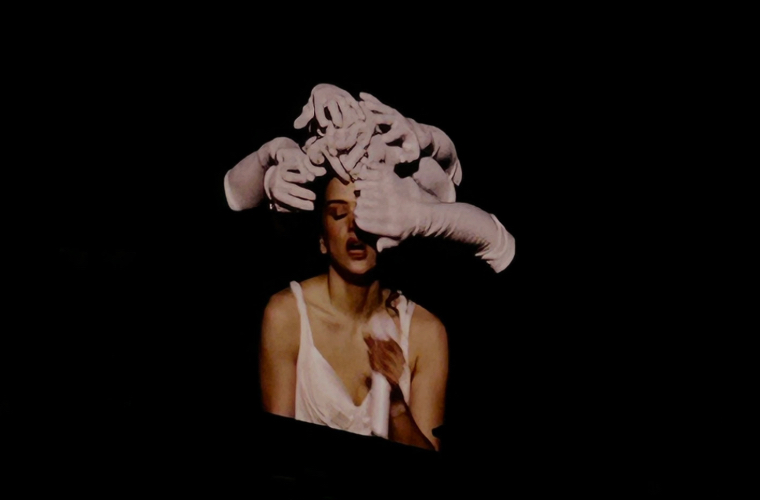
As the Mona Lisa, the star is charismatic and cheeky, styling out a spirited rendition of Franki Valli’s ‘Can’t Take My Eyes Off You’. As the Venus de Milo, transformed as such by the white opera gloved hands of her dancers, she is gentle, reminiscing on an unfortunate entanglement with a playboy.
Above all, she is light – lux – as she darts across the stage barefoot wearing white feathered wings. And then, wings shakily outstretched at the top of some white stairs, she falls backwards and ascends. It is the last we see of her.
Understanding is not the purpose of the Lux tour. That would be impossible. I am lucky to know two languages. But that is not thirteen. Nuns and saints from the 16th century are not common knowledge. Nor are a lot of the artworks referenced in the performance.
But feeling. Feeling is Rosalía’s purpose. To feel human, to feel heaven. That was what she wanted, and it is certainly what she delivered.
Featured image credit: Katie Bevan

Join the discussion