In the 1970s, a colony of European tree frogs, a species once found in 16th Century Britain, was inadvertently – and illegally – reintroduced to south east London.
Although their survival was short-lived, now conservationists at Celtic Rewilding – a group which works with landowners, farmers, nature groups and NGOs, specialising in species reintroduction – are assessing whether these tiny frogs could be ethically reintroduced, along with moor frogs and agile frogs.
This will involve a lengthy feasibility period to analyse key risks, funded by Rewilding Britain . The organisation is seeking more funding in order to further the project via their gofundme.
These three species of frog have been revealed to be native through a combination of fossil evidence and historical records. The native status of these species is discussed within a Winston Churchill Fellowship report published this month.
Harvey Tweats, a conservationist and the director of Celtic Rewilding, said: “We believe in managing and restoring nature at a whole ecosystem level.
“We will help anyone from a small inner-city garden to a national park.”
According to Celtic Rewilding, moor frogs used to thrive in lowland bogs that have now largely been destroyed by drainage and activities such as peat-cutting.
Their return to UK ecosystems would mark the restoration of functioning peatlands, crucial for biodiversity and carbon storage.
The return of agile frogs, once native to East Anglia, would signal the recovery of open-woodland systems, once lost due to the wholesale cutting of our forests.
The European tree frog’s resilience to freezing winters perhaps makes it suitable to thrive in the UK.
Could organisations like Celtic Rewilding facilitate the return of the species to south east London?
Some unexpected guests could help make this possible – beavers.
Beavers make dams by cutting down logs and branches, producing ponds with low flow rates.
According to charity Froglife, this tree-felling opens gaps in the forest canopy which allows more light to reach the forest floor and water surface.
This increases temperatures and rotting wood is produced, promoting invertebrate diversity and habitat complexity. These effects are all potentially favourable for amphibians, the charity writes.
Celtic Rewilding have embarked on a new project called Britain’s Lost Frogs, with the goal of investigating whether moor, agile and European tree frogs could return to Britain.
The agile and moor frog are the current priority with tree frogs being studied at a later date.
Tweats said: “These are species of frog we’ve lost within the last 500 years or so. Up to 40% of Britian’s amphibians have gone extinct within this time period.”
One of Tweats’ findings from his trip around Europe was that these species need intact nature and large areas of their respective habitat.
The agile frog prefers slightly open damp woodland, the European tree frog enjoys scrubland and open parkland with ponds and the moor frog thrives in bogs and fens.
Tweats said: “These three habitats are very rare in Britain. We have chopped down most of our woodland, by about 1900 we were less than 5% woodland cover.”
“We also used to have about 50% peatland cover across the UK and we’ve destroyed over 99% of our peat bogs.
“With the European tree frog, we actually collected it for medicine, and I believe this, combined with the drainage of wetland, exterminated them.
“This drainage also exterminated the moor frog alongside harvesting peat. Before coal, peat was the number one source of fuel.”
Celtic Rewilding have recently been funded by Rewilding Britain to conduct a study at a site in Norfolk; this will be the first place to release these frogs.
All three species are particularly suited to habitats in south east England which could make London a great place to release them in the future, after the feasibility works have been completed.
Tweats said: “The great thing with London is that it is very warm because of the urban heat island effect.
“The European tree frog and agile frog always show up on Species Distribution Models as really good in London because of this heat. Although more data is needed.”
The organisation can help support rewilding in London, if anyone owns or manages some land and wants to get in touch they can do through Celtic Rewilding’s website.
Tweats suggests that these species could be successfully released if lengthy studies and a disease risk analysis are performed, pointing out that beavers are the key to reintroducing the species to London.
He said: “Beavers help to restore these habitats and in the case of the agile frog, beavers open up the woodland canopy and get light to the ground by creating their dams which is great for them.”
“For European tree frogs they provide really shallow ponds for them to breed in, creating that open space, and for moor frogs they rewet big areas.”
He explained we need wild beavers to be reintroduced into a variety of habitats across London for all three species to be thrive in the city.
Tweats said: “These frogs are very important to eaters of invertebrates, they control mosquito and pest populations and are an amazing source of food for animals like otters, storks, herons, egrets, grass snakes and even pike.
“These are all species that rely on a healthy wetland with lots of frogs.”
These frogs could also allow people to engage with the natural world in an urban environment. For example, Tweats observed that in Belgium, many education programmes are formed around the European tree frog with children being allowed to partake in the raising and release of them.
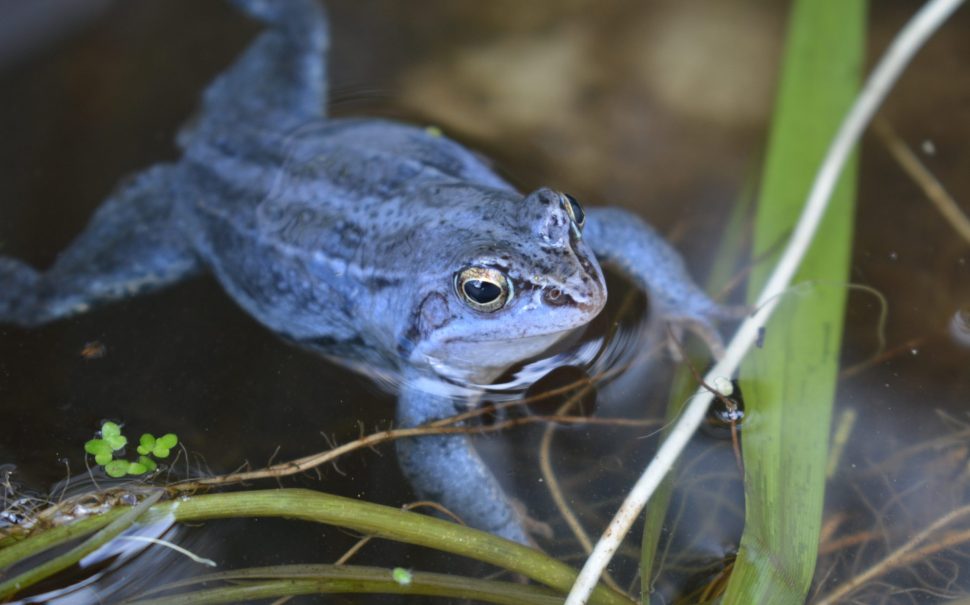
With male moor frogs turning a vibrant shade of blue in spring to attract mates and warn off rival males, we could soon start to see similar excitement and engagement in the UK around this spectacle.
“These frogs could be a brilliant way of connecting more people with nature,” Tweats said.
Although frogs do not directly reduce carbon levels, Tweats said: “Some American studies have found that when there’s a healthy amphibian population, because they eat things like woodlice and earthworms, forests draw down carbon.
“When there is an overpopulation of woodlice and earthworms, the breakdown of leaf litter releases methane and C02. By bringing in a predator, soils can proliferate.
“Wetlands, generally, are also our most important carbon sink, especially peat bogs.”
Celtic Rewilding are looking into whether captive breeding could work to safely raise the number of frogs required for successful reintroduction.
“We already operate a captive breeding centre with all these species, which has established the basics of breeding these frogs, but we need to make modifications that enable the necessary scale and produce disease free stock,” Tweats said.
“We’re looking for any serious environmentalists who would like to donate money, we have a couple of people already which is really exciting.
It has recently been revealed that white storks and beavers will make a historic return to east London thanks to the Mayor’s Green Roots Fund which has awarded £3.48million to support 26 environmental projects, 11 of which will support waterways.
The fund also pledges to invest more than £12million over three years to help nature thrive across London’s communities.
This new investment from the Mayor of London will see beavers return to Barking and the first white storks breeding colony in London for 600 years.
In light of the Department for Environment, Food and Rural Affairs’ (DEFRA) decision to legalise the release of wild beavers under license, Dr Sean McCormack, project lead and license holder at The Ealing Beaver Project said: “Although they’ve said they are going to issue licenses, so far about 40 projects have expressed interest in applying for a license and only three licenses have been granted.
“All three of these licenses are retrospective because they are in areas where wild beavers have already shown up, rather than licensing future releases.
“Instead of the government shirking their responsibility and telling community-led projects like ours: ‘You need to manage and mitigate beavers in the landscape if you’re going to apply for a license’, we would say that actually the government has targets for not only tackling the climate crisis but also the biodiversity crisis.
“Beavers, if they’re managed well, can be a real tool in hitting those targets.”
Will the Mayor’s Green Roots Fund accelerate DEFRA’s licensing or begin and end with releasing beavers in Barking?
According to McCormack, because beavers are a species we exterminated in Britain, we have a moral and legal obligation to bring them back as a native species.
He said: “The beavers can tolerate quite high-nutrient systems and a level of pollution that some more sensitive species can’t.
“By making their system of dams, which act as a giant filtration mechanism, they create these incredibly complex wetlands which filter water and improve water quality, increasing the value for more sensitive species such as these three frogs.
“We’re going in monthly and doing our water quality testing and we’re seeing improvements from where the water enters the site to where it leaves the site because of all the beaver’s activity.”
Like Britain’s lost frogs, beavers actually help the government to reach climate targets.
McCormack said: “Trees and wetlands are cooling our cities, beavers capture a lot of carbon into their wetlands and hold water on the land.
“This mitigates for flooding in times of high rainfall by slowing the flow and releasing the water gradually downstream.
“The Ealing beavers actually stopped flooding downstream of Paradise Fields, the site of the project, last winter.
“It was the first time in over a decade that the area around Greenford tube station and the residential streets around there did not flood because of mass rainfall events surging the system.
“Beavers also mitigate for drought by holding more water on the land, which acts as a refuge for other wildlife such as amphibians.
“But no one’s compensated us for that, there’s a saving there and it’s hard to quantify.”
People might argue that bringing back a little frog is inconsequential, but McCormack has other ideas.
“The little frog can be a symbol to get people on board, to say ‘we don’t want that area built on because that’s a wetland system that has these amazing frogs that were once extinct,” he said.
“It’s not really about the little frog, it’s about trying to build back functioning ecosystems and all the little parts of the puzzle build up a more resilient landscape.
“I always say that it’s like a game of Jenga: if we start taking out little pieces bit by bit and fragmenting the puzzle of the ecosystem, the whole thing will come crashing down.”
Featured image credit: Jack Perks Wildlife Media / Celtic Rewilding Copyright 2025
Join the discussion